Wednesday, June 29, 2011

Looking for Themes: Parts


One of the first things a creator is taught is not to include everything. Whether you are painting or writing or photographing, it's rarely a good idea to include the entire subject, and especially steer clear from the habit of putting a subject dead center in your frame. When I taught fiction writing, I would talk to my students about not including every single detail when describing a scene or a character's entire life story. Why not? It's boring. Where's the mystery? Where's the drama? The conflict? This is what readers and viewers want (as do we, as fans of art).


To create visual tension in your photos, place your subject partly out of the frame. This can create a sense of motion (and, thus, mystery: where's that car headed?). It can create a desire in the audience to want to know more.

Pushing the subject partly out of frame means you, the artist, have to decide what to include and exclude and to what border are you pushing it? Push it up, and the subject may look like it's taking flight. Include only a person's hands, and the wrinkles tell the story of a hard life.


This is something I enjoy doing. I like to create interest in a subject that may not at first seem worthy of our attention. By photographing only a part of it, I can draw a person's eyes to it. One of the most satisfying responses I get is, "I never knew a _____ could be so beautiful."

It's nice to be a part of that discovery.


G


Friday, May 6, 2011

Looking for Themes: Trees


It's early summer, and I still haven't shot much lately, except for some family snapshots with the little point and shoot, and I'm again thinking about how immersed I was in photography, and how I'm not at all now, and the reason why it could change so quickly.


Water was a theme that jumped out at me when I began considering this topic. It was obvious. And I initially thought that beyond that, not much else would be. I figured I'd have to do some digging and perusing to locate more themes. I was surprised, though, at how many more became obvious with just a quick look through my file folders.


To continue with nature photography, today I'm going to share some of my photos of trees. I'm drawn to them for a number of reasons and on a number of levels. Simply, they are lines. Their trunks create vertical patterns when in bunches and a split-screen when standing alone. Either way, the effect is very graphic and solid, a juxtaposition of positive and negative at its most basic.

Beyond this simple design element, trees are deeply symbolic. They are stoic and powerful. They play an important role in both nature and our own human history. With the bittersweet falling of a tree, we can literally count its age and know its own history. They amaze us with their fortitude. They tower above us, humbling us and our petty issues.

I suppose it's a tree's perseverence that I respect the most. Year after year, they are present, they stand their ground, and they do not complain.


So opposite from so many of us.


-G


Monday, March 7, 2011

Looking for Themes: Water

I've shot very little in the last few months -- both my cameras have had battery problems, and there was the upheaval of the holidays and a lot of time spent on other projects, all mixed in with the busy-ness of life as an at-home parent.

You know what? I haven't missed shooting all that much.

I look back at my photos from the last few years, and I may as well have taken them a decade ago, they feel so far away. I appreciate them and am proud of the work I've done and how much I've learned in the past five years, but I have absolutely no urge to shoot now.


As with my writing, when I look closely at my photos, I see recurring themes. I don't plan them -- they just happen. I appreciate that spontaneity. I trust it. So maybe these themes will tell me something.

I'm going to try to explore the themes and subjects in my photos to see if I can get to the heart of my 'problem', one that's been eating at me for as long as I can remember: why do I swing so far and so quickly (and so predictably) from one interest to another? How is it possible to be so immersed in photography for several months, then go several more without any urge to shoot? Why does the same thing happen with writing and music? Is there something in my work that reveals a sort of answer?


First up is water. It terrifies me. I have so many negative memories of it: I remember standing on the diving board at swim class, hearing the egging on from friends and lifeguards that quickly went from encouragement to annoyance. It took me forever to jump in the deep end, and when I did, I grasped for the aluminum pole that would pull me to the surface. Helpless.

I remember nearly drowning while racing my brother into deeper water on Lake Sacandaga. I remember being the only one of my friends who didn't swim across the reservoir and back. I remember Dan pretending he was drowning. I remember talking nervously while on boats and making excuses not to walk out to the end of a dock. I have had so many nightmares about drowning, about my kids drowning, about needing to stay afloat, and not being able to.


I am trying to take control of this fear. I took swim lessons recently, and we bought a place on the lake last summer. I've even gone out kayaking by myself (staying close to shore).

And through all of this, water's been one of my favorite subjects to write about and photograph. I understand why people crowd around lakes and retreat to the water when they seek solace. I do the same thing; I just don't jump in like most people.

Is 'jumping in' a metaphor for taking chances in life? For relying on one's simple yet amazing ability to keep yourself afloat? Why have I started to test myself in the water now, when all I've done in the past is admire it from a distance? Is my recent string of disillusionments with the reality of creative pursuits leading to some sort of revelation that I'm spending my life watching and not doing, creating and not being? Do I just need to let go?

Boy, that's heavy for a Thursday morning.

-G

Tuesday, November 16, 2010

Teaching

Emily


Last fall, I taught my first photography course. It started up when I met a family at an art show a few weeks earlier. We got to talking about photography and cameras, and then they asked if I taught classes. I hadn't, but said I could, and after a few phone calls, we set up some times. The daughter in the family asked some friends to join, and we eventually had a group of five.

I chose a few local spots at which to meet -- a DEC nursery, a state park -- figuring they would give us good opportunities to discuss composition. We talked about vertical and horizontal lines, eliminating background clutter, and the rule of thirds. After each meeting, the students emailed me some of their photos and I'd respond with feedback and suggestions.

Taylor

Hope


It was the best kind of experience -- accidental -- and it reminded me of what I truly enjoy, whether it has to do with photography or some other pursuit. I really, really like to teach. I love the learning process, being a student, being a teacher, and just experiencing knowledge being passed on. From taking classes myself in art and literature, to teaching composition and creative writing, to teaching my daughter to play guitar and my son to read, I enjoy every bit of the whole experience.

Stephanie

The students were great listeners and real troopers, too, considering the wind and cold we dealt with. I was truly impressed with their work. They applied the techniques we discussed and in just a few weeks, each individual's style was evident.

Here are just a few of the student photos. You can see them all here.

Thanks for looking,

G

Valerie

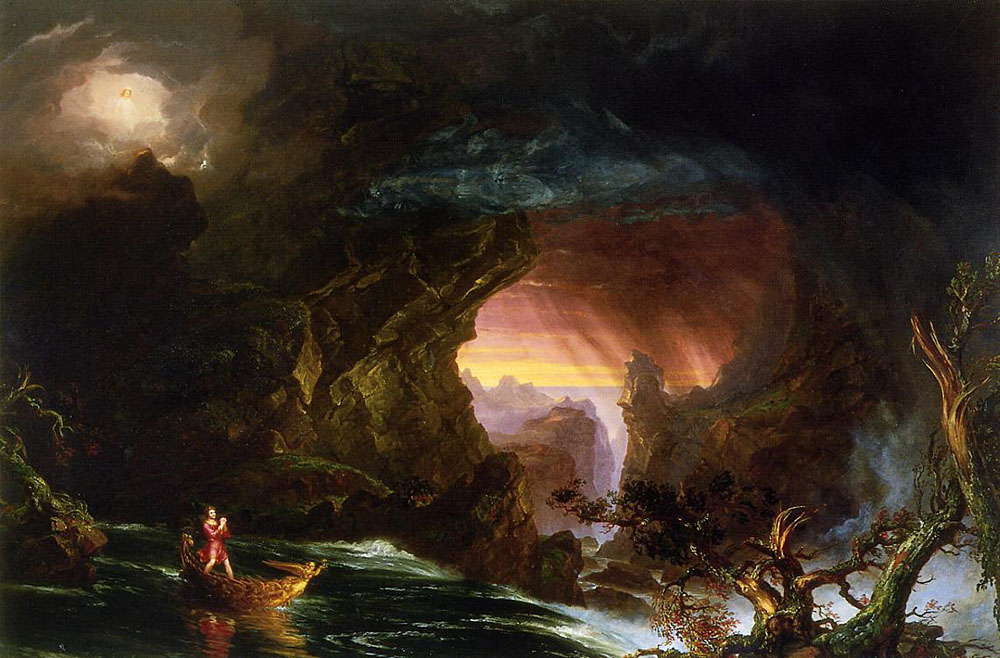
The Voyage of Life

As an at-home dad, I don't get a lot of time to myself, and usually when I do take time for myself, I golf or go out shooting or I run errands in peace, savoring a few minutes of uninterrupted sports radio. But recently, I chose to forego that sort of excitement for a more subtly stimulating trip to the museum. I hadn't been feeling very inspired lately, and it had been a few years since I visited the Munson Williams Proctor museum in Utica. Plus, I wanted to visit the only camera shop within two hours of home, so off I went. It was an hour drive each way, meaning I'd have two whole hours of sports radio and music. Uninterrupted. Amazing. From previous visits to MWP, I remembered Jackson Pollack's enormous Number 2 and Thomas Cole's Voyage of Life.

I also remembered wandering around the museum during high school field trips with Mr. C. Looking back, I was even more thankful for those outings -- not only for the escape from school for a few hours, but for the opportunity to wander, to stare, to stand still. This time, I wandered and stared, but also talked to the gallery assistants about when and why Cole's works were moved to an alcove, about the designing of the museum itself, and about Ann Reichlin's 914 Whitesboro Street project, in which she captures "that state between falling apart and building, that tension between what was and what might be." She writes that she is "fascinated by the idea of potential embedded in the states of abandonment, demolition, and buildings in the process of construction. Once a building is falling apart, one imagines what it might have been."


This project hit a nerve with me, as I've always been drawn to abandoned places, trying to recreate their stories, the world in which they thrived, and the moment at which it was decided that people would leave them forever. Ironically, I realize now that her exhibit is no longer at MWP. It's been deconstructed, removed, and all that's left are a few photos, I assume. Needless to say, most of my time that day was spent in that room, thinking about abandonment, the passing of time (the Voyage of Life...), and the bittersweet understanding that nothing will last -- not a photograph, not the memory of someone who took that photograph, not the digital backup file, not the name, nothing. And as depressing as that may sound, it's liberating, too. It's actually a nice thought, when you think about it. Nothing stays, so why stress over it? We're all blips in time (food for worms), and our homes are just piles of wood and stone, and even famous and not-so-famous works of art disintegrate in time, bridges crumble and whole towns are abandoned, so why worry so much? Sometimes I wish we lived closer to museums, but we don't. It's nothing to stress over. G

Thursday, October 28, 2010

A New Old Way

click for larger photos

Like most photographers today, I shoot digital. I do have a film SLR and I use it from time to time, but I'm not as patient as I'd like to be. Also, I've never worked in a darkroom. Instead, I send out my film for processing and printing.

Back in the late 80's when I attended SUNY Oswego, I wanted to take the photography courses, but I could barely afford to pay for laundry as it was. I was a dual major in English and Art, but took illustration, painting, and drawing. Those supplies were expensive enough. I knew from friends in the art department that photography was not a cheap pursuit. It wasn't a huge disappointment or anything. I just thought it was a cool medium that I thought I'd want to explore some day.


I feel now as if I have somehow cheated, jumping right over film photography and landing in the world of the digital darkroom, where things seem...easier. I don't know if they are; that's just my perception. Sitting at the computer working in Photoshop doesn't seem as blood-and-sweat as standing in a cramped darkroom, dodging and burning, mixing chemicals, and drip-drying prints. I would guess that that feeling has something to do with the ingrained guilt of growing up Catholic -- you feel bad even when there's nothing to feel bad about.

Some day, I'd like to try out the darkroom experience, just for the sake of it. There is that idealized image of the lone artist laboring away under a red light, watching as his/her work fades into being.

I'd like to try that and see just how wrong that idealized image is.

I want to go "old school," as they say, to some degree. I know how important it is to study those who came before you. Like learning blues riffs on the guitar or copying word for word your favorite writers in order to get a better sense of their style, their cadence.

Other older techniques I'm interested in -- going backward to go forward? -- are pinhole photography and lomography. I love the gloomy, fuzzy quality of older photographs. The over-saturated colors of 1970's pocket cameras. The soft focus of the earliest cameras.

I recently bought a zone plate from Pinhole Resource. Basically, it's a camera body cap with a tiny hole drilled in the middle. It's more complicated than that, but you get the idea. I went out shooting by the Black River in Watertown and these are some of the shots. At f/45, the DOF is enormous and of course, the necessary shutter speeds are slow. It was fun. Kind of the best of both worlds -- a simple lens (if you can even call it that), combined with the instant review of digital. It's a beautiful thing.

G


Tuesday, October 5, 2010

Final Show of the Season


Harvest of the Arts 2010


On October 2nd and 3rd, I went back to where I started -- the Harvest of the Arts in Lowville, NY. Two years ago, I set up for my first show at the Harvest. I had no idea what I was doing, what to sell, how to sell, what people buy, and would people buy my work.

Two years and a dozen or so shows later, I'm still unsure, but I've also learned a lot. I'm having fun and meeting a lot of nice people. The 'oohs' and 'ahhs' from people who walk into my booth are much-needed ego boosts, and surrounding myself with my own prints for two days is both exhilarating and horrifying.

While I've learned a lot about photography in just two years, there is also much, much more to know, of course. And, thankfully, I continue to enjoy learning about the processes that take photos from 'eh' to 'wow'. Having made a break from fifteen years in education -- as an aide, a counselor, a program coordinator, and a college professor -- it's comforting to find myself wholly and happily studying something new. For a while there, I felt I was drifting at sea.

Still, teaching remains a possibility. This weekend, I had a number of people ask if I taught classes. I have thought about it briefly, but hearing the interest this weekend has made me consider it even more.

Along with the how-to book I'm planning, and the courses I want to study myself....and the restorations I'm working on....and the commercial jobs that came up this weekend...teaching workshops would keep me pretty busy. And happy.

G

From the Kite Festival, which coincided with the Harvest this year.